
AGM Battery Charger: Complete Guide to Choosing the Right One
An AGM battery charger is designed to safely charge Absorbent Glass Mat batteries, a type of sealed lead-acid battery commonly used in modern cars, motorcycles, boats, backup systems, caravans and other vehicles. Unlike a basic battery charger, a charger with a dedicated AGM mode can use a charging profile suited to the characteristics of AGM batteries.
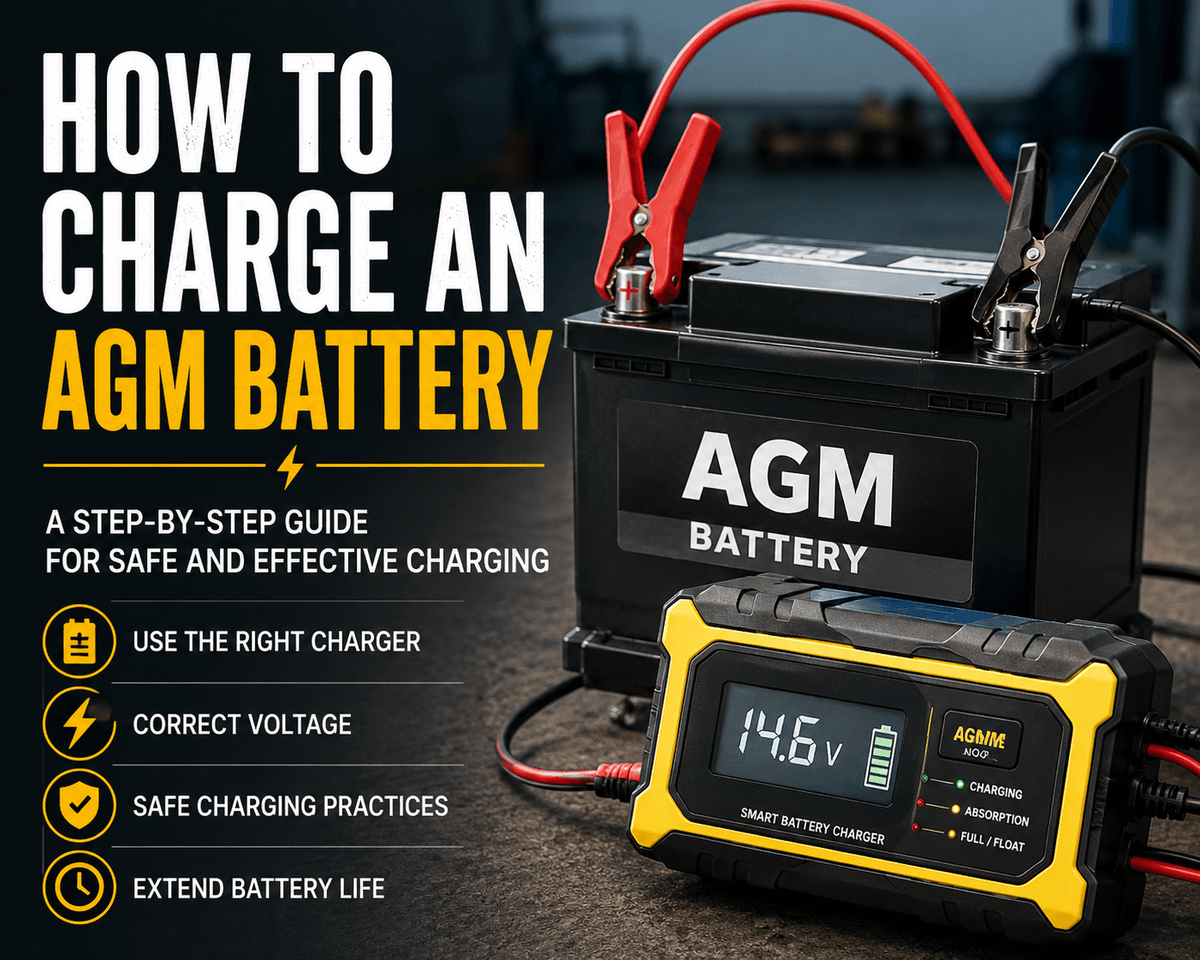
For most 12V AGM batteries, a smart charger is the easiest option because it can automatically regulate charging, reduce the risk of overcharging and switch to a maintenance mode when the battery is full. Choosing the right charger still matters, however, because voltage, charging current, battery capacity and charger compatibility all affect charging performance.
This guide explains how AGM batteries work, what charger you need, how to choose one in South Africa, common mistakes to avoid and when an AGM charger is worth buying.
What Is an AGM Battery?
AGM stands for Absorbent Glass Mat. It is a type of valve-regulated lead-acid battery (VRLA) in which the electrolyte is absorbed into fibreglass mats between the battery's lead plates.
This construction makes AGM batteries different from conventional flooded lead-acid batteries.
AGM batteries are popular because they can offer:
-
Low maintenance operation
-
Good resistance to vibration
-
Strong starting performance
-
Good power delivery
-
Sealed construction
-
Reduced risk of electrolyte spilling during normal use
-
Suitable performance for vehicles with high electrical demands
They are commonly found in vehicles equipped with start-stop systems, although the exact battery specification varies by vehicle.
AGM batteries are also used in applications such as:
-
Cars and SUVs
-
Motorcycles
-
4x4 vehicles
-
Boats
-
Caravans
-
Solar and backup systems
-
Security and alarm systems
-
Electric equipment
Because AGM batteries have specific charging requirements, using a charger with an appropriate AGM setting is generally preferable.

AGM Battery Charger: What Does It Do?
An AGM battery charger supplies electrical energy to an AGM battery using a charging process appropriate for that battery technology.
A modern smart charger normally progresses through several stages. Depending on the charger, these may include:
-
Battery testing or diagnosis
-
Bulk charging
-
Absorption charging
-
Float or maintenance charging
The charger adjusts its output according to the battery's condition rather than continuously delivering maximum current.
This is particularly useful for vehicles that spend long periods parked.
Why Use a Dedicated AGM Mode?
AGM batteries can require a different charging profile from conventional flooded batteries. A charger with an AGM mode is designed to account for this difference.
Some smart chargers also have additional settings for:
-
Standard lead-acid batteries
-
AGM batteries
-
Gel batteries
-
Lithium batteries
-
Motorcycle or small batteries
-
Cold-weather charging
-
Battery maintenance
Always check the battery manufacturer's charging specifications before selecting a charging mode.
How to Choose an AGM Battery Charger
Choosing the right charger is easier when you focus on five important factors: voltage, charging current, battery capacity, charging mode and safety features.
1. Check the Battery Voltage
The most common automotive AGM battery is a 12V battery.
However, don't assume every battery is 12V.
Check the label or manufacturer's documentation before connecting a charger.
For example:
|
Battery |
Suitable Charger |
|
12V AGM car battery |
12V AGM charger |
|
12V AGM motorcycle battery |
12V charger suitable for small batteries |
|
24V battery system |
Appropriate 24V charger |
|
6V AGM battery |
Compatible 6V charger |
A charger should match the battery system voltage.
2. Consider Charging Current
Charging current is normally measured in amps (A).
A small charger may be suitable for a motorcycle battery, while a larger automotive battery may benefit from a charger capable of delivering more current.
For example, a 4A or 5A smart charger can be useful for maintaining or gradually charging many smaller and medium-sized batteries. A higher-output charger can reduce charging time for larger batteries, provided its specifications are appropriate for the battery.
Don't select a charger based only on maximum amperage.
The charger's compatibility with the battery is more important than simply choosing the highest available output.
3. Look for an AGM Charging Mode
If you own an AGM battery, look for a charger that specifically lists AGM mode or provides charging specifications suitable for AGM batteries.
This feature can make the charger more versatile and reduce the need to guess which charging profile to use.
4. Choose a Smart Charger
A smart battery charger can automatically monitor the battery during charging.
Useful features may include:
-
Automatic voltage detection
-
Battery condition monitoring
-
Automatic current adjustment
-
Overcharge protection
-
Short-circuit protection
-
Reverse-polarity protection
-
Float or maintenance mode
-
Temperature compensation on some models
For everyday vehicle owners, a smart charger is usually more convenient than a basic manual charger.
5. Check Battery Capacity
Battery capacity is commonly expressed in amp-hours (Ah).
A charger should be appropriate for the battery's capacity and intended use.
For example, a charger designed primarily for small motorcycle batteries may not be the best choice for a large AGM battery used in a 4x4.
Always compare the charger's recommended battery capacity range with the specifications printed on your battery.
AGM Battery Charger vs Standard Battery Charger
Not every charger is equally suitable for every lead-acid battery.
|
Feature |
AGM Charger |
Basic Charger |
|
AGM charging profile |
Usually available |
May not be available |
|
Automatic charging |
Often |
Sometimes |
|
Maintenance mode |
Common |
Less common |
|
Overcharge protection |
Usually on smart models |
Varies |
|
Ease of use |
High |
Moderate |
|
Battery monitoring |
Common on smart models |
Limited |
|
Best for long-term maintenance |
Yes, if designed for it |
Not always |
A basic charger can be useful for certain applications, but a smart AGM-compatible charger provides greater control and convenience.
Benefits of Using an AGM-Compatible Charger
There are several reasons to choose a charger specifically designed to support AGM batteries.
Better Charging Control
A suitable charging profile helps the charger deliver the correct charging process rather than treating every battery type identically.
Automatic Maintenance
If the charger includes a float or maintenance mode, it can be useful when a vehicle is stored for an extended period.
For example, a classic car, caravan or second vehicle that is rarely driven may benefit from proper battery maintenance.
Added Safety Features
Modern smart chargers commonly include protective features such as reverse-polarity and short-circuit protection.
These features don't eliminate the need for careful use, but they can reduce the likelihood of common charging errors.
Convenient for Vehicle Owners
A smart charger can reduce the amount of manual monitoring required during normal charging.
Pros and Cons of an AGM Battery Charger
Pros
-
Designed for AGM battery characteristics
-
Smart models can regulate charging automatically
-
Useful for vehicle battery maintenance
-
Available in compact portable designs
-
Many models support multiple battery types
-
Can include several safety protections
Cons
-
AGM-compatible chargers can cost more than basic chargers
-
Not every model supports every battery chemistry
-
Some chargers have limited output for large batteries
-
Incorrect voltage selection can damage a battery
-
A charger cannot necessarily recover a severely damaged battery
How to Charge an AGM Battery
Before charging, read the battery and charger manufacturer's instructions.
A typical process is:
-
Park the vehicle safely and switch off electrical accessories.
-
Check the battery for visible damage, swelling or leakage.
-
Confirm that the charger voltage matches the battery.
-
Select the AGM charging mode if the charger provides one.
-
Connect the charger according to its instructions.
-
Switch on the charger.
-
Allow the smart charger to complete its charging cycle.
-
Check that the charger indicates a full or maintenance state before disconnecting.
The exact connection procedure can vary depending on the vehicle, charger and battery manufacturer's instructions.
Never ignore unusual heat, damage, swelling, smell or other signs that something is wrong with the battery or charging system.
Common AGM Charging Mistakes to Avoid
Even a high-quality charger cannot compensate for incorrect use.
Using the Wrong Voltage
Connecting a charger with the wrong voltage rating is one of the most serious mistakes.
Always verify the battery specification first.
Selecting the Wrong Battery Mode
If your charger has separate settings for standard lead-acid, AGM and lithium batteries, choose the setting recommended for your battery.
Do not select a lithium charging mode for an AGM battery.
Using Excessive Charging Current
More amps do not automatically mean better charging.
Use a charging current appropriate for the battery's size and the charger's specifications.
Ignoring a Damaged Battery
A battery that is swollen, cracked, leaking or otherwise physically damaged should not simply be connected to a charger.
Have it inspected or replaced as appropriate.
Leaving a Basic Charger Connected Indefinitely
A charger without an appropriate automatic maintenance function should not necessarily be left connected indefinitely.
If long-term maintenance is your goal, choose a charger specifically designed for that purpose.
AGM Battery Charger Buying Guide for South Africa
South African motorists have a wide range of vehicles and driving conditions, from daily commuter cars to 4x4s, caravans and recreational vehicles.
When shopping for an AGM charger in South Africa, consider the following:
For Daily-Driven Cars
A compact 4A–5A smart charger may be useful for routine charging and maintenance, depending on battery capacity.
For Large SUVs and 4x4s
Look for a charger with sufficient output for the battery's capacity and a clearly specified AGM charging profile.
For Motorcycles
Choose a charger that supports small AGM batteries and has a low-current or motorcycle-compatible setting.
For Caravans and Stored Vehicles
A smart charger with a proper maintenance or float mode can be especially useful when the battery is not used frequently.
For Workshop Use
A workshop may benefit from a higher-output charger with multiple battery modes, diagnostics and robust safety features.
Who Should Buy This?
An AGM-compatible charger is particularly useful for:
-
Drivers with AGM-equipped vehicles
-
Motorcycle owners using AGM batteries
-
4x4 and SUV owners
-
Caravan owners
-
People who store vehicles for long periods
-
Drivers who want a battery maintenance solution
-
Workshop owners who work with different lead-acid battery types
If your vehicle uses a conventional flooded battery and you only need occasional charging, an AGM-specific model may not be necessary unless you want its additional features and compatibility.
How Long Does an AGM Battery Take to Charge?
Charging time depends on several factors, including:
-
Battery capacity
-
Battery state of charge
-
Charger output
-
Battery condition
-
Charger efficiency
-
Temperature
A small battery connected to an appropriate charger may charge considerably faster than a large automotive battery.
A deeply discharged battery can take many hours to recharge.
Instead of relying on a fixed charging time, use the charger's status indicators and follow the manufacturer's instructions.
Can You Use a Normal Charger on an AGM Battery?
It depends on the charger.
Some chargers are compatible with AGM batteries even if they do not prominently advertise themselves as an "AGM charger." Others may use a charging profile that is not appropriate.
The safest approach is to check the charger manufacturer's specifications and confirm that it supports AGM batteries.
A modern multi-stage smart charger with a dedicated AGM setting is generally the straightforward choice.

Can an AGM Battery Be Overcharged?
Yes. Excessive or inappropriate charging can cause problems with an AGM battery.
This is why choosing a suitable charger and following the battery manufacturer's charging specifications is important.
A quality smart charger can help by controlling the charging process and switching into an appropriate maintenance state when the battery reaches the required level.
However, never assume that every charger can safely remain connected indefinitely.
AGM vs Gel vs Flooded Battery
Different lead-acid battery designs can require different charging approaches.
|
Battery Type |
Typical Characteristics |
Charger Consideration |
|
AGM |
Sealed, vibration-resistant, high power delivery |
Use AGM-compatible profile |
|
Gel |
Sealed and gelled electrolyte |
Use appropriate gel setting |
|
Flooded |
Traditional liquid electrolyte |
Use conventional lead-acid profile |
|
Lithium |
Different battery chemistry |
Requires lithium-compatible charger |
The battery chemistry should always be confirmed before charging.
Tips for Getting Better AGM Battery Life
Proper charging is only one part of battery care.
To help maintain your battery:
-
Avoid leaving the vehicle unused for very long periods without maintenance.
-
Keep battery terminals clean and secure.
-
Check the battery manufacturer's recommendations.
-
Investigate repeated low-battery problems instead of repeatedly charging the battery.
-
Check the vehicle's charging system if the battery repeatedly becomes discharged.
-
Use a suitable battery maintainer when appropriate.
-
Avoid unnecessary electrical loads when the engine is switched off.
If a relatively new AGM battery repeatedly loses charge, the problem may be the vehicle's electrical system, parasitic drain or alternator rather than the battery itself.
5 Best Features to Look For
If you're comparing several AGM chargers, prioritize these features:
-
Dedicated AGM mode – Helps provide an appropriate charging profile.
-
Automatic multi-stage charging – Reduces the need for constant monitoring.
-
Maintenance/float mode – Useful for vehicles stored for long periods.
-
Reverse-polarity and short-circuit protection – Adds an extra layer of protection.
-
Suitable current output – Make sure the charger matches your battery's capacity and intended application.
Internal Linking Opportunities
If this article is published on an automotive website, consider adding internal links to related content such as:
-
Best Battery Charger for Cars – Link from the charger buying section.
-
Smart Battery Charger Guide – Link when explaining automatic charging.
-
How Long Does a Car Battery Last? – Link from the battery maintenance section.
-
Jump Starter vs Jumper Cables – Link when discussing emergency starting equipment.
-
Common Car Battery Problems – Link when explaining repeated battery discharge.
These links can help create a strong automotive battery content cluster.
External Authority Sources to Reference
For additional technical credibility, consider referencing authoritative information from:
-
Battery Council International (BCI) – Battery industry information and terminology.
-
Battery University – Educational material covering rechargeable battery technologies and charging principles.
-
South African Bureau of Standards (SABS) – Relevant South African standards and product-safety information.
When publishing, link to the specific pages that directly support the technical claims you make rather than adding unrelated external links.
Image Ideas and SEO Alt Text
Image 1: AGM Battery and Charger
Alt text: AGM battery connected to a smart AGM battery charger
Image 2: AGM Charger Display
Alt text: smart 12V AGM battery charger showing charging status
Image 3: AGM vs Standard Battery
Alt text: comparison of AGM battery and conventional car battery
Image 4: Battery Charger Buying Guide
Alt text: features to check when choosing an AGM battery charger
Image 5: AGM Battery Maintenance
Alt text: car AGM battery being maintained with a smart battery charger
Frequently Asked Questions
1. What is the best AGM battery charger?
The best AGM battery charger depends on your battery voltage, capacity and intended use. For most vehicle owners, a smart 12V charger with a dedicated AGM mode, automatic charging and a maintenance function is a practical choice.
2. Can I charge a 12V AGM battery with a normal charger?
You can only do so if the charger is specified as compatible with AGM batteries and uses an appropriate charging profile. Check the charger's instructions before connecting it.
3. What voltage should an AGM battery charger use?
Most automotive AGM batteries are 12V systems, but the correct charging voltage depends on the specific battery and charger design. Always follow the battery manufacturer's specifications rather than choosing a voltage based only on the battery's label.
4. Is a smart charger better for AGM batteries?
A smart charger is often a convenient option because it can automatically regulate the charging process and, on suitable models, switch to a maintenance mode after charging. It should still be specifically compatible with the AGM battery.
5. Can I leave an AGM battery on a charger?
Only leave it connected for extended periods if the charger is specifically designed for long-term battery maintenance and the manufacturer permits this use. A basic charger should not automatically be assumed to be safe for indefinite connection.